Set Decoration
An Analysis of the Visual Fabric of Emerald Fennell’s Latest Film, “Wuthering Heights” (2026)
In Emerald Fennell’s “Wuthering Heights”, extreme distortions of the source material and a will to dispense with period accuracy are manifest, and proudly so. But from an aesthetic viewpoint, how well do the film’s endless reimaginings of Regency styles hold up without these frameworks tying them together?
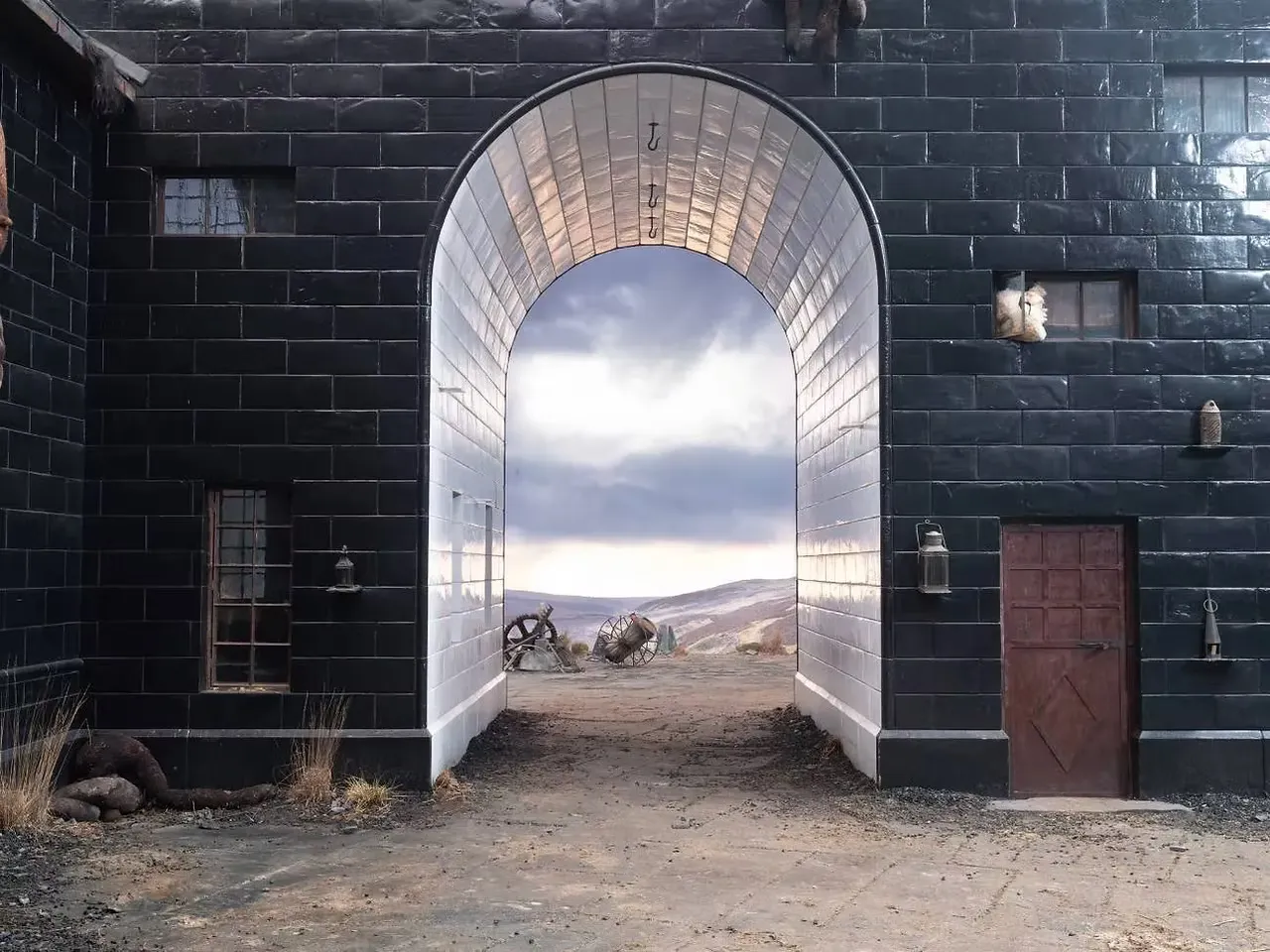
The archway connecting the Earnshaw family home, Wuthering Heights, to the Yorkshire moors, clad in uniform, glossy tiles. Image: Jaap Buitendijk / Warner Bros.
Emerald Fennell’s Wuthering Heights (2026) is designed to provoke in both form and content. It does not aspire to offer a faithful adaptation of Emily Brontë’s 1847 novel, but aims, instead, to envisage a love story between Cathy and Heathcliff through the lens of a 14-year-old Fennell, reading the book in the 1990s.
Such a framework, which renders the plot only about as comparable to Brontë as Saltburn (2023) is to Evelyn Waugh’s 1945 Brideshead Revisited, taken together with Fennell’s proclivity towards maximalist aesthetics produced an interesting challenge for the costume and set design teams.
Just as the film openly refuses to stay close to Brontë, so, too, in its visual vocabulary, does it consciously stray from, but not entirely dispense with, period correctness, adopting the inventive strategy of refashioning historically accurate silhouettes for clothing, architecture and decoration in the designers’ choices of materials.
This technique is by now well-tried, and has elsewhere been executed to great effect, notably in Sofia Coppola’s Marie Antoinette (2006), whose sets and costumes clearly inform those of Wuthering Heights. Yet departing from historical design precedents is no easier than attempting to do them justice by remaining faithful to them, since it opens up limitless options to the designer with regards to referential, stylistic and other formal decisions.
At stake is coherence of both an interscenic and intrascenic nature, and Fennell’s Wuthering Heights struggles, at times, for both.
The film’s set design was headed by Suzie Davies, with set decoration by Charlotte Dirickx. Unlike other contemporary cinematic takes on historical source material, which tend to work on the audience’s subconscious through small dressing, Wuthering Heights substitutes meticulous furnishing of sets for emotionally charged, high-impact spaces which are generally speaking decoratively sparse.
Visual paradoxes play an indispensable role in the aesthetic communication of the film, and the most overarching of these is the divide between the Earnshaw family home, Wuthering Heights, and that of the Linton family, Thrushcross Grange.
The former location is characterised by its extreme compositional irregularity, darkness, and the mark of the untamed natural environment, with craggy shards of grey rock looming over the grouping of contorted domestic buildings, whilst the latter is a wedding cake-like, pastel blue, prettified Regency mansion, exuding absolute symmetry, brightness and cleanliness.
In material choice, too, the properties are antithetical: the sets of Wuthering Heights draw on the inhospitable surrounding Yorkshire Moors landscape, constructed in wood, rock, marble and other natural materials, whilst those of Thrushcross Grange are pristine, rendered so through the use of dazzling, contemporary artificial materials, from cellophane curtains to high-shine red vinyl floors.

The stone and wood interior of the panelled parlour at Wuthering Heights, with its irregular, rock-cut fireplace at the back of the room. Image: Jaap Buitendijk / Warner Bros.

The high-shine red vinyl floor of the library at Thrushcross Grange. Image: Jaap Buitendijk / Warner Bros.
The effectiveness of the juxtaposition between the two primary locations, however, is somewhat let down by the timing of their respective introductions in relation to the unfolding of the narrative.
Earlier scenes take place at Wuthering Heights, and later ones at Thrushcross Grange, and whilst the two settings are effectively counterposed by the end of the film, the first appearance of the second property, coming with an aggressive ranking up of surrealism, creates a stylistic mismatch so stark that it scrambles the overall tone of the film, which had previously felt clear and confident.
With the new sets comes an uncomfortable visual adjustment from historical reference to contemporaneity, reality to unreality, and nature to artifice, as what was a colourful but worldly, nuanced reinterpretation of the sartorial, architectural and decorative traditions of Regency England in the pre-Thrushcross scenes becomes an alien aesthetic formula that is now doubly displaced: by the source material in the first instance, and by a historical framework in the second.

Young Heathcliff, played by Owen Cooper, and young Cathy, played by Charlotte Mellington, at the rough-hewn Wuthering Heights set, wearing costumes that playfully refashion historical Regency period dress. Image: Jaap Buitendijk / Warner Bros.

Cathy Earnshaw, played by Margot Robbie, wearing an iridescent pink-tone cellophane dress that strays from Regency period precedents in both silhouette and composition. Image: Jaap Buitendijk / Warner Bros.

Cathy Earnshaw and Edgar Linton, played by Shazad Latif, in the dining room at Thrushcross Grange. Cathy wears an off-the-shoulder, black latex dress that seems little inspired by Regency costume. Image: Jaap Buitendijk / Warner Bros.
The issue is not with the decision to insert these decorative eccentricities and fanciful anachronisms in itself, since, consistent with Saltburn, they are important components of the distinct visual vocabulary for which Emerald Fennell is known.
Nor is it the case that the objective of their inclusion is unclear; particularly in the second half of the film, outlandish costumes and sets are renewed at a delirious pace, manifestly serving as a visual counterpart to Margot Robbie and Jacob Elordi’s acting out of the obsessive, feverish relationship between Cathy and Heathcliff.
Such aesthetic abundance and puzzled sense of place, constructed in particular around the figure of Cathy, does, indeed, successfully build on the audience’s sense of her progressively disturbed condition. The problem, rather, lies with the unsubtle handling of movements across the line between reality and unreality, as otherworldly details which begin to encroach on a more frequent basis with the introduction of Thrushcross Grange lack counterparts in the first half of the film.
In fact, the only uncanny features in the pre-Thrushcross sets are the building and archway at Wuthering Heights which are inexplicably clad in symmetrical, mass-produced, rectangular ceramic tiles, making little sense in a surrounding set that expressly derives its power from its resolute asymmetry.
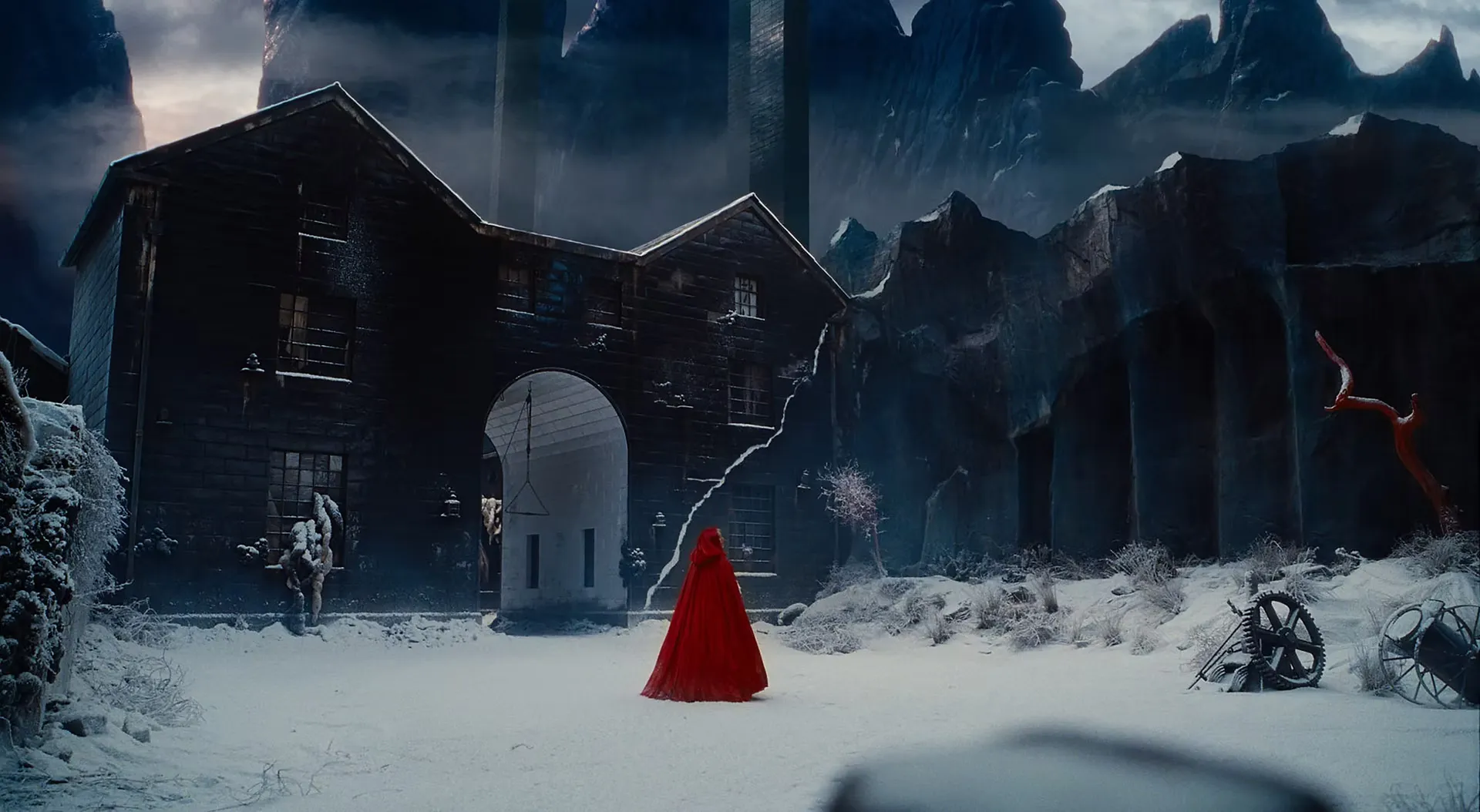
The exterior of the main house at Wuthering Heights, clad in uniform rectangular tiles and surrounded by asymmetrical masses of grey rock. Image: Jaap Buitendijk / Warner Bros.
According to both Fennell and Davies, textural decisions were made in consideration of their emotive effect in the first instance, and any relation to the source material or historical context in the second. Yet even in light of this, the mysteriously clad buildings at Wuthering Heights do not represent the only instance in which such material choices seem ungrounded.
Around the middle of the film, as Cathy moves to Thrushcross Grange and the rooms, drenched in scintillating synthetic materials, are at their most highly stylised point, such fabrics as the blood-red faux fur that lines the underside of the marble Grand Staircase seem to have been selected for the sole reason of their audacity.
Likewise, at Wuthering Heights, decorative details like the orange leather-upholstered interior door of an otherwise conventionally dressed, historic stable block does more to interrupt the film’s visual integrity than to add to it. In a set walkthrough with Architectural Digest, Davies highlighted this latter detail as an example of a design choice made “just to give elements that are quite weird and unusual”.
Unapologetic anachronisms in the set and costume design are entirely justified and even desirable for a film with a title such as this, but with such eclectic material choices and a lack of small dressing taken together, the sets fall short of the depth of feeling they set out to evoke, and, at times, feel more like the setting of a music video or Christmas advertisement than the backdrops of a cinematographic remake of Emily Brontë’s novel.
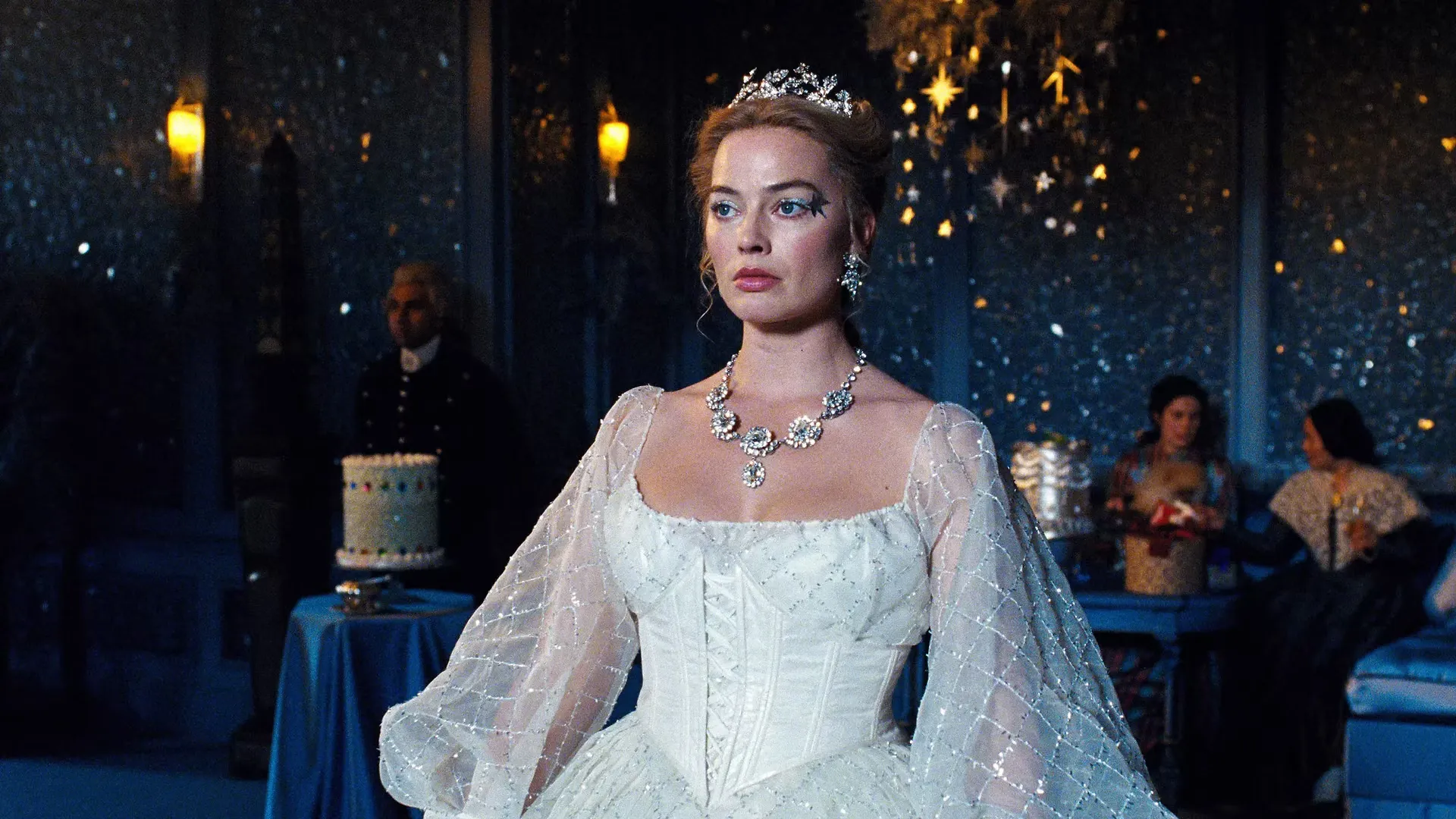
Cathy Earnshaw, played by Margot Robbie, wearing a white winter-style dress with sheer glittery sleeves. She stands in the drawing room at Thrushcross Grange, with its crystalline, plastic-panelled walls. Image: Jaap Buitendijk / Warner Bros.
A discussion of the visual fabric of Emerald Fennell’s Wuthering Heights would not be complete without an acknowledgement of the multiple points at which the design flourishes. One notable triumph within the set design is the dining room at Thrushcross Grange, which is particularly striking for the detail of the hemispherical plastic ornaments arranged, festoon-like, in the manner of Regency plasterwork around the silvered walls. Cathy’s bedroom, too, deserves praise.
Covered on all its surfaces in padded panels that display blown-up images of Margot Robbie’s freckled, veiny skin, the visceral space offers a physical expression of wordplay on the Georgian term ‘skin-room’: the sort of wooden-panelled closet described in the opening chapters of Brontë’s book. At the same time, it creates a subtly engulfing environment around its primary inhabitant, whose own decision to tie herself to the Linton family is a fundamental cause of her later misery.
Finally, the repeated motif of the doll, which carries over from the public hanging in the opening scene, reappears in Cathy and Heathcliff’s childhood bedrooms at Wuthering Heights, and finds its symbolic culmination in the claustrophobic doll’s house in the dining room at Thrushcross Grange, is undeniably effective.

The dining room at Thrushcross Grange, featuring walls painted in silver and festooned with transparent plastic elements arranged in a manner emulative of Regency-style plasterwork. Image: Jaap Buitendijk / Warner Bros.

Cathy’s bedroom at Thrushcross Grange, lined on every surface with close-up prints of Margot Robbie’s skin as a visual pun on the Georgian term ‘skin-room’. Image: Jaap Buitendijk / Warner Bros.
In the weeks following the release of Emerald Fennell’s Wuthering Heights, the film has gained an extraordinary level of coverage in the media, and has understandably left critics divided. With its extreme narrative warping of a novel that occupies a prime position within the English literary canon, the film was always going to separate purist from popular audiences, and it is worth acknowledging that it markets itself towards the latter.
In terms of set design, it is fearless, recasting Regency-inspired forms in artificial materials that are at times as crazed as the protagonists who occupy them. The question remains, however, whether the film resonates strongly enough as a coherent, independent piece to compensate for the extent of its subversion of the source material, and diversion from historical models. Although there are undoubtedly moments of excellence within its set design, there are just as assuredly a great many inconsistencies.
Ultimately, out-of-place components within the sets, unfounded material choices, and awkwardly handled visual paradoxes outweigh the high points, leaving the audience with an overall impression of stylistic incoherence for which the film, regrettably, suffers.
References
Architectural Digest, ‘Inside Heathcliff’s Gothic “Wuthering Heights” Home’, video, 6 February 2026, YouTube, 00:08:23. Accessed 23 February 2026.