Set Decoration
Experiencing the Lunar Landscape on a Cosmic Scale: A Review of The Moonwalkers: A Journey with Tom Hanks
From exquisitely clear images of the lunar landscape to archival footage of the 1969-1972 Apollo missions, The Moonwalkers: A Journey with Tom Hanks (2025) stages the formidable stories of past and future moon landings on a cosmic scale itself.
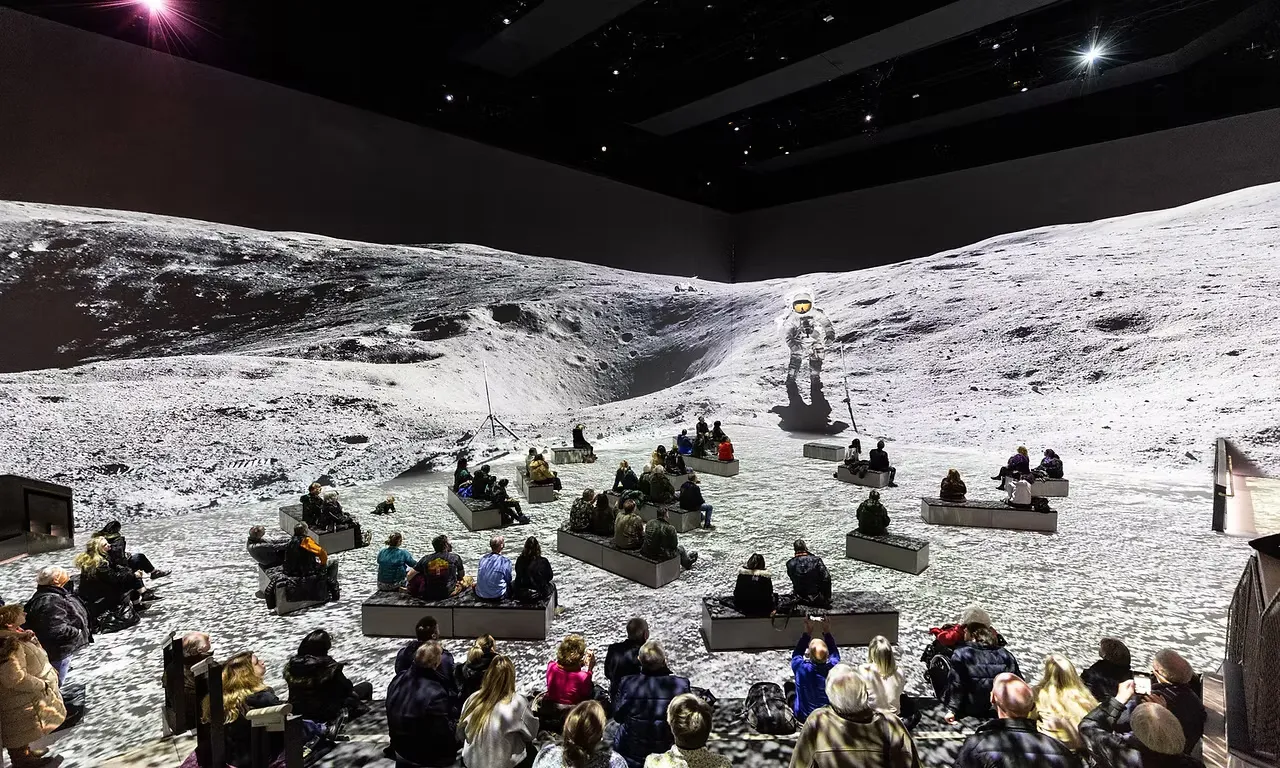
An Apollo austronaut walking on the surface of the moon. Still from The Moonwalkers: A Journey with Tom Hanks at the Lightroom, London. Image: Justin Sutcliffe/Lightroom.
The Moonwalkers: A Journey with Tom Hanks (2025) is an immersive, hour-long cinematic experience at London’s Lightroom that makes use of projectors on every surface of its large subterranean exhibition space to tell of the significance of the 1969-1972 Apollo moon landings. At its core a documentary, co-written by narrator, Tom Hanks, and filmmaker Christopher Riley, and directed by Lysander Ashton and Nick Corrigan, The Moonwalkers also anticipates NASA’s 10-day Artemis II expedition, the first crewed mission to the moon since Apollo 17 in 1972, set to take off on 1st April 2026. Whilst The Moonwalkers upholds one clear narrative theme, focusing on historical and upcoming human expeditions to the moon’s surface and orbit, it does not offer a scientific, technically informative, nor even particularly contextualised account of either. Yet empirical, instructive documentary storytelling is not the point of The Moonwalkers, which, instead, takes advantage of the Lightroom’s engendering a sense of total visual envelopment to present mesmerising images of the lunar landscape, footage of earth from space, and the spectacle of space exploration itself, on the jumbo scale they merit.

An Apollo austronaut walking on the surface of the moon: close-up image. Still from The Moonwalkers: A Journey with Tom Hanks at the Lightroom, London. Image: Justin Sutcliffe/Lightroom.
The documentary opens with a focus on the moon as an object of human fascination throughout history, locating its mythological and symbolic significance, and advancing the reasons why the impetus to place humans on the moon should have come about in the first place. If not in the montage of moon themed images and artefacts from prehistory to the present, this point is impressed upon the audience with the reverberating audio of President John F. Kennedy’s ‘we choose to go to the Moon, not because it is easy, but because it is hard’ speech of 12th September 1962, which accompanies footage of the ecstatic Rice University audience on all four of the Lightroom’s 11 metre tall walls. No details of the geopolitical undercurrents of the Apollo missions with the space race and the Cold War are divulged before the 16th July 1969 blast-off of Apollo 11’s 363-foot-tall, three-stage rocket, The Saturn V (SA-506), takes over the projectors, but in a cinematic experience which privileges sensation over information, such oversights are justified. The remainder of the documentary interjects colossal re-enactments of the Apollo moon landings, revived in high-definition archival imagery, with anticipatory snippets of the preparations for Artemis II, and skilfully establishes a sense of continuity between the attitudes surrounding the 1960-1970s missions and those of their 2026 successor.


From a visual point of view, The Moonwalkers at the Lightroom is nothing short of breathtaking. Especially striking, in the first part of the documentary, is the prolonged scene of the departure of The Saturn V (SA-506) from the Kennedy Space Centre, plunging into a thalassic blue sky until it is little more than a minute spark with a slight, trailing wake. Soon afterwards, wide shots of the earth’s marble-like surface, a rolling blue ball depicted from outer space, are accompanied by exhilarating classical music that injects something of the flavour of 2001: A Space Odyssey into the space scenes. After what, Tom Hanks explains, is a four day voyage across the ocean of stars from the surface of the earth to that of the moon, the staggeringly rudimentary Lunar Module Eagle, occupied by Apollo 11 astronauts Neil Armstrong and Buzz Aldrin, pops up on the walls, its little aluminium feet the first to gather moondust. What follows is the series of high-definition stills taken over the course of the Apollo missions, and these, undoubtedly, are the highlight of The Moonwalkers. Given the practical nonexistence of atmosphere on the moon, and, by extension, the total lack of air or dust in between the camera’s lens and its subject, these images are exquisitely clear. In shots of the lunar landscape with its rolling hills and valleys, almost familiar but for their absolute stillness and eerily cool grey colouring, the moon emerges as a phenomenon situated somewhere between closeness and distance, tangibility and total, immeasurable, mind-boggling mystery.

An Apollo astronaut conducting a scientific experiment on the surface of the moon. Still from The Moonwalkers: A Journey with Tom Hanks at the Lightroom, London. Image: Justin Sutcliffe/Lightroom.
In the weeks leading up to the launch of NASA’s Artemis II, The Moonwalkers: A Journey with Tom Hanks at London’s Lightroom reminds viewers of the motivations for, and accomplishment involved in lunar exploration, harking back to the Apollo moon landings of 1969-1972 in doing so. The documentary does not aspire to tutor its audience in any scientific or historical capacity, but, rather, to stage visuals associated with the extraordinary events that were the moon landings on the cosmic scale they deserve. Punctuating teasers for Artemis II with astonishingly clear photographs and archival footage from the Apollo missions, the cinematic experience makes palpable phenomena so far removed from the average person’s frame of reference, making The Moonwalkers is a truly compelling watch.