20th Century
Absurd Rules, Deceitful Perspectives: a Visit to Tomaso Buzzi's La Scarzuola
Veiled by a canopy of trees in the wild, rough-hewn hillside of rural Umbria lies the complex of La Scarzuola, the creative apotheosis of architect Tomaso Buzzi which is at once a Mannerist garden and a Surrealist cityscape.
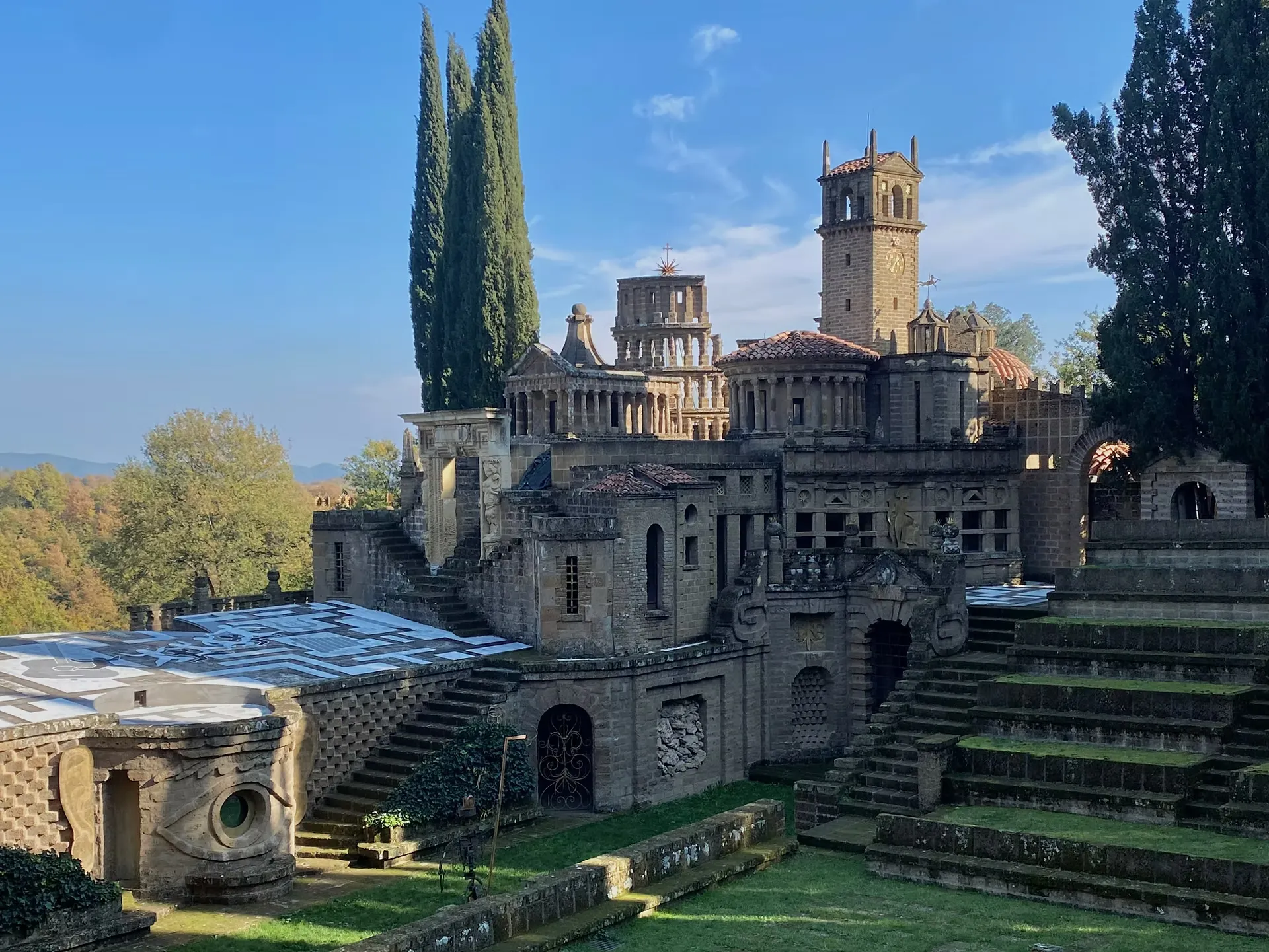
Set outside the hamlet of Montegiove, in the Umbrian hills near Montegabbione, lies the neo-Mannerist complex of La Scarzuola.
The magnum opus of Italian architect Tomaso Buzzi (1900–1981), La Scarzuola, built, for the most part, between 1958 and 1978, takes the form of a tufa stone kingdom: a pastiche of familiar monuments and whimsical ‘amphitheatres’, warped in perspective and amalgamated into an architectonic parade of cultivated rock so to accord with one another within a single, chimerical creative scheme.
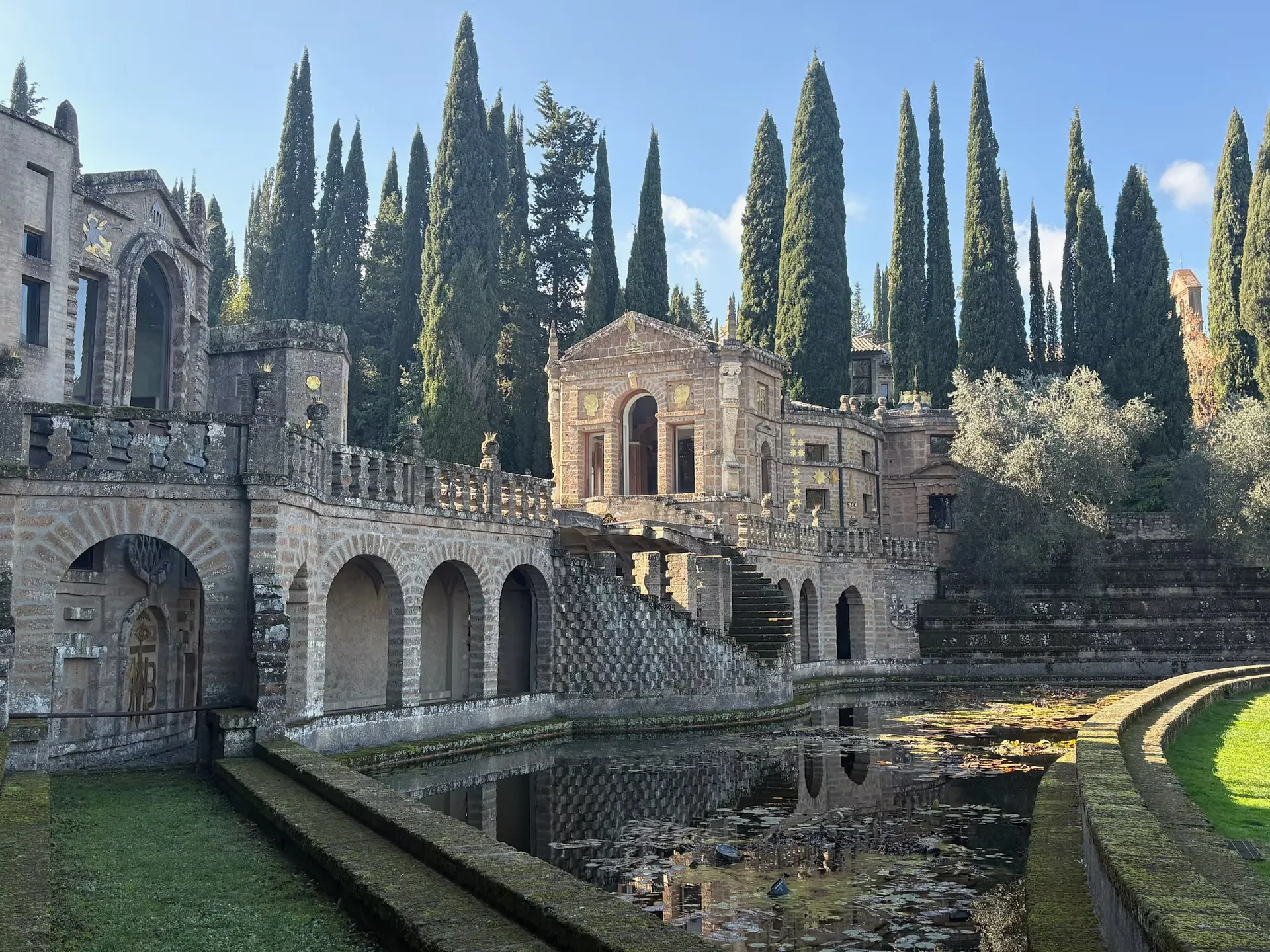
Diana's Nymphaeum, with the backdrop of the Stage of the Teatrum Mundi, La Scarzuola. Image: author
La Scarzuola is a Piranesian capriccio in three dimensions, an eclectic concoction of built references to structures and ideas preserved elsewhere in stone, books, and legend: here the Tower of Babel; there the Colosseum; there the material incarnation of Claude Nicolas Ledoux’ haunting, visionary sketch, ‘Coup d’Oeil du Théâtre de Besançon’. It is as sublime as the wildest fabrications of Étienne-Louis Boullée, and just as replete with esoteric refinements.

Claude Nicolas Ledoux (1736–1806), 'The Interior of the Theatre at Besancon Reflected in the Pupil of an Eye', from L'architecture considérée sous le rapport de l'art, des moeurs et de la législation, 1804. Image: Bibliothèque nationale de France

The eye of “ATB” (Architetto Tomaso Buzzi) overlooking the Theatre of Bees at La Scarzuola. Image: author
The complex, sprawled out over a gently sloping hill, comprises seven ‘Amphitheatres of Life’: the Theatre of Bees, the Well of Meditation, the Temple of Eros, the Stairway of Life, the Tower of Despair, the Whale of Stone, and the Boat of Souls.
Interconnected through their sharing of physical or symbolic motifs, the amphitheatres together serve as a repository of the knowledge gathered by Buzzi over his lifetime, translating into stone the precepts, theories and musings of figures such as Filarete, Ligorio, Palladio, Borromini, Maurits Cornelis Escher and Salvador Dalí.
Yet there is something unsettling in the sham status of La Scarzuola’s structures, which, like perishable components of theatrical scenery, seem transient: towers remain unfinished, staircases lead to nowhere, and columns, visitors are told, are prone to tumbling.
In the copiousness of its follies, and in such brazen details such as the mammoth nude torso of la Grande Madre, it propagates an atmosphere of excess, so that in strolling the grounds of La Scarzuola, the visitor might be journeying through the lived fantasy of Hieronymus Bosch’s c. 1492–1504 The Garden of Earthly Delights.
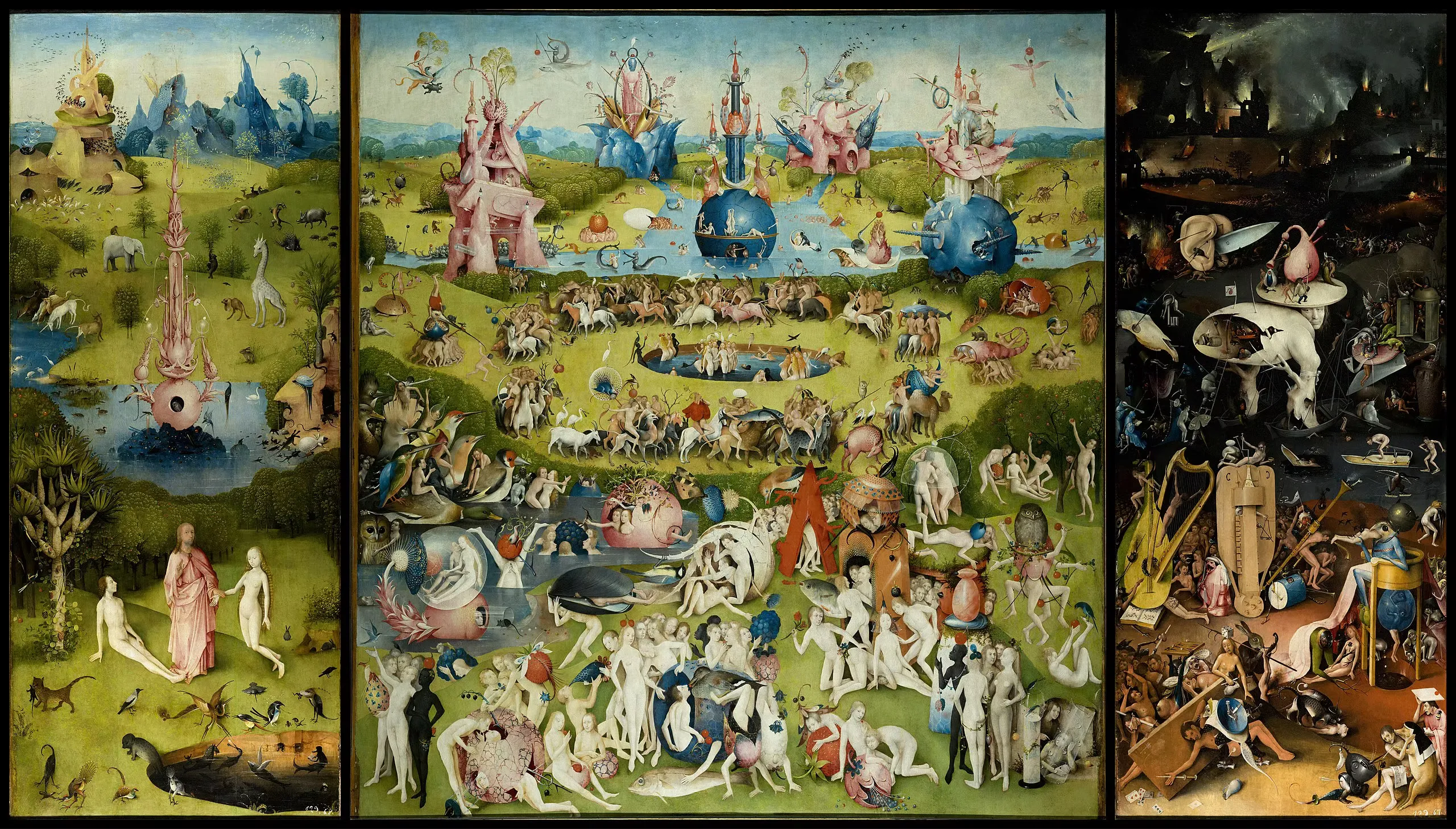
Hieronymus Bosch, The Garden of Earthly Delights, c. 1492–1504, oil on panel, 205.5 cm × 384.9 cm, Museo del Prado, Madrid. Image: Wikimedia Commons
The visitor should not expect to derive any demystifying details about the architecture from the only guide authorised to offer tours at La Scarzuola: its proprietor, Marco Solari. Solari is Tomaso Buzzi’s nephew, who possesses a temperament as capricious and freakish as the pleasure ground over which he keeps watch.

The signature of "ATB" (Architetto Tomaso Buzzi), La Scarzuola. Image: author

la Grande Madre (the Great Mother), forming part of the perimeter wall of the Temple of Eros, La Scarzuola. Image: author
Like a clockwork toy in the moments before and after its key is turned, Solari flits between states of quiet composure and fits of erratic, uncontrollable laughter as he roams his territory, treading conceptual tightropes from Francesco Colonna to Carl Jung, and only referencing the surrounding architecture to embellish his monologue about the nature of the human condition.
Yet the very eccentricity of Solari’s tour intensifies, rather than lessens, the pervasive atmosphere of unreality that makes a visit to La Scarzuola the unique experience that it is.
In the undeniably visionary quality of its architectural programme throughout, Buzzi’s La Scarzuola finds a close parallel in the imagined metropolises described by Italo Calvino in his 1972 novel, Invisible Cities: ‘Cities, like dreams, are made of desires and fears, even if the thread of their discourse is secret, their rules are absurd, their perspectives deceitful, and everything conceals something else.’
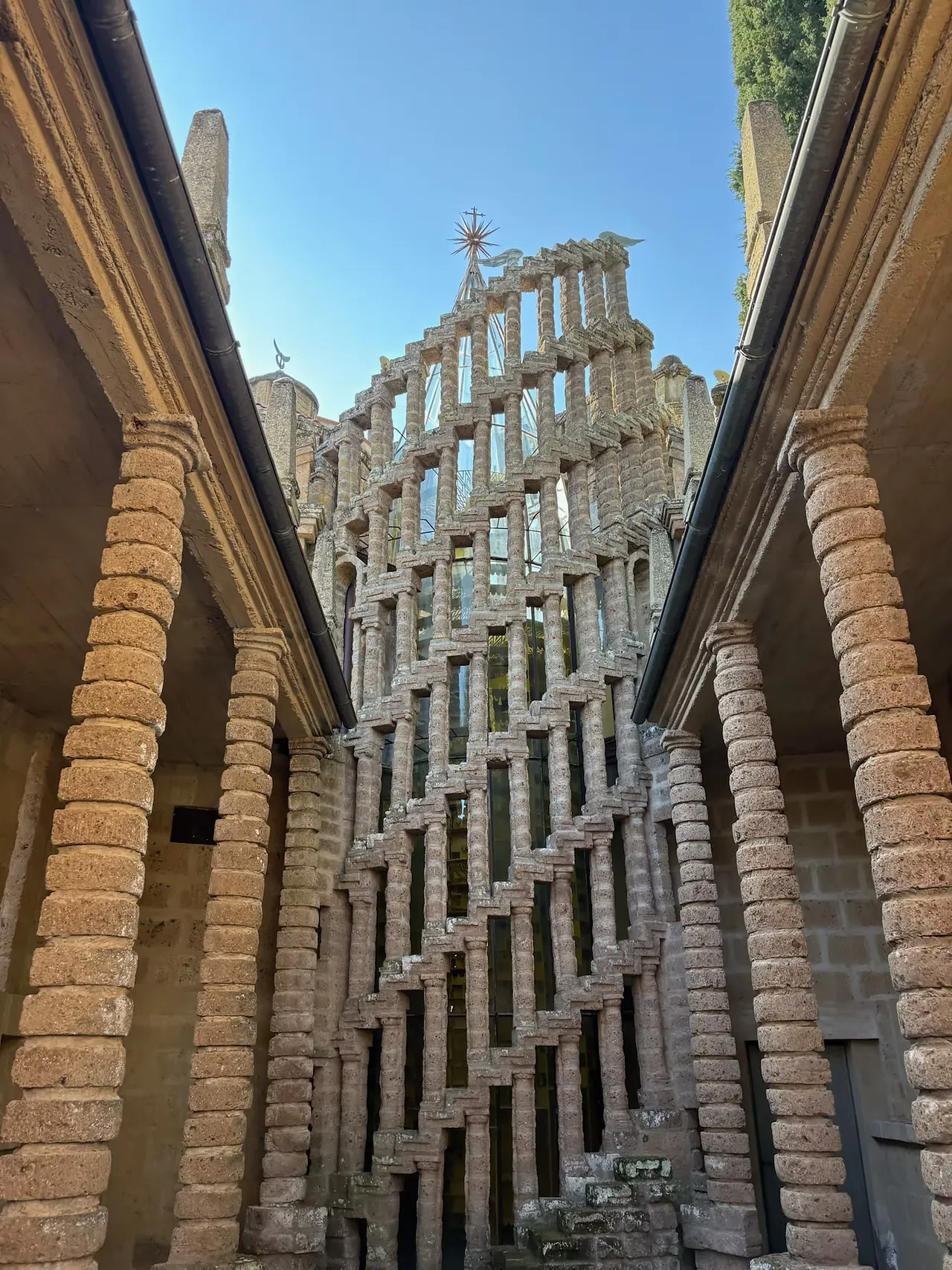
The Tower of Babel, encasing the Staircase of the Seven Octaves of knowledge, La Scarzuola. Image: author
References
Italo Calvino, Invisible Cities (San Diego: Harcourt Brace & Company, 1974)
Santi Centineo, ‘Mental and emotional processes in two post-Bomarzian parks: Buzzi’s La Scarzuola and Saint Phalle’s Tarot Garden’, in Creating Through Mind and Emotions, ed. by M. Ming Kong, M. do Rosário Monteiro, M.J. Pereira Neto (London: CRC Press, 2022), 365–371
Walter Mariotti, ‘Italian journey: La Scarzuola, a surrealist project of tuff, iron and psychoanalysis’, Domus, 1084 (2023)
Luca Pasquarelli and Chiara A. Ripamonti, ‘Buzzinda: Walking through an Architectural Metaphor of the Jungian Individuation Process’, Psychological Perspectives, 59:3 (2016), 319–337