Set Decoration
Design in Stanley Kubrick's 2001: A Space Odyssey (1968)
From Arne Jacobsen flatware to Olivier Morgue Djinn chairs, the sets of Stanley Kubrick’s 2001: A Space Odyssey represent the very best of space age design within its own cultural moment.
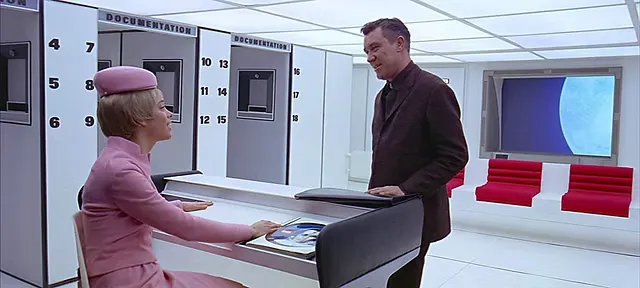
Chela Matthison as the receptionist Miss Turner on Space Station V, wearing a costume designed by Hardy Amies, who would later design cabin crew uniforms for British Airways Concorde planes. Image: © Warner Bros. Entertainment Inc.
From Arne Jacobsen flatware to Olivier Morgue Djinn chairs, the sets of Stanley Kubrick’s 2001: A Space Odyssey represent the very best of space age design within its own cultural moment. Released in 1968, the film propagated an aesthetic of the “future” that fed directly back into the sphere of contemporary interior and furniture design, helping to steer a trend in bold, minimalistic silhouettes that remained popular until the decline in space age aesthetics with the plastics crisis of the mid-1970s.
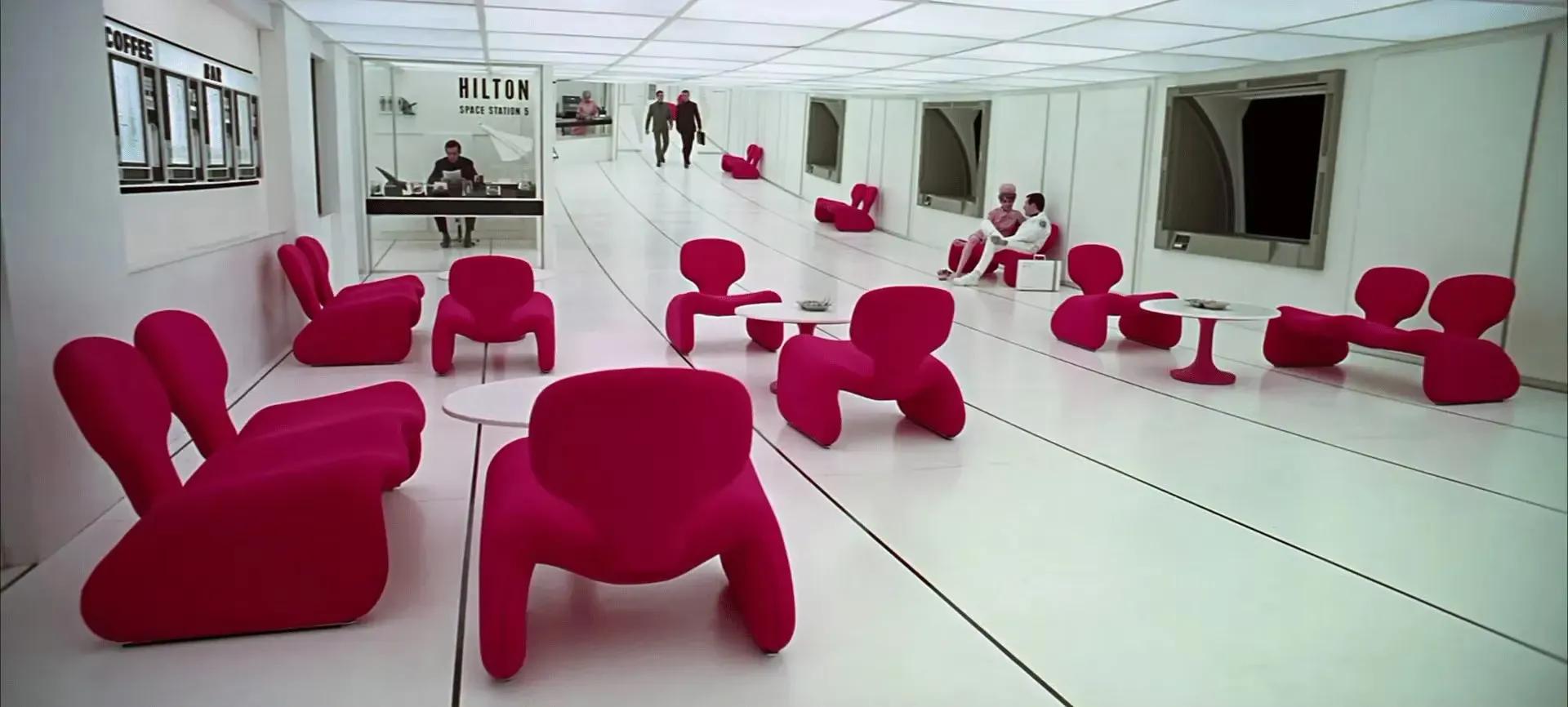
Olivier Morgue, double and single seater Djinn chairs for Airborne International, 1965. Pictured alongside Tulip-style tables after Eero Saarinen in the Hilton lobby of Space Station V on the set of *2001: A Space Odyssey*. Image: © Warner Bros. Entertainment Inc.
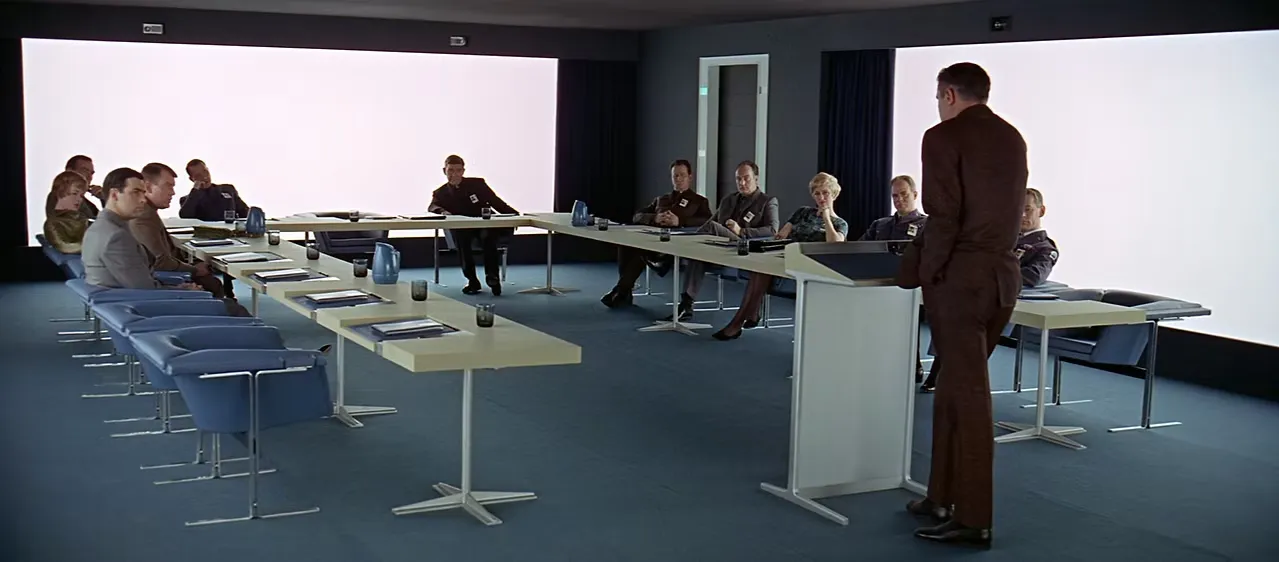
The blue conference room in *2001: A Space Odyssey*, complete with Geoffrey Harcourt Model 042 lounge chairs for Artifort, 1963. Image: © Warner Bros. Entertainment Inc.
Whilst tapping into the realm of technological impossibility, such sets as the spherical interiors of the Pan Am “space clipper”, commissioned by Kubrick of NASA designer Harry Lange, are, crucially for Kubrick, both structurally and stylistically plausible.
These attributes both bind the film further to its historical context, with the preparations for the 1969 Apollo 11 moon landing going on over the course of its production, and set it apart from other science-fiction films of the 1960s, which were more fantastical in style.
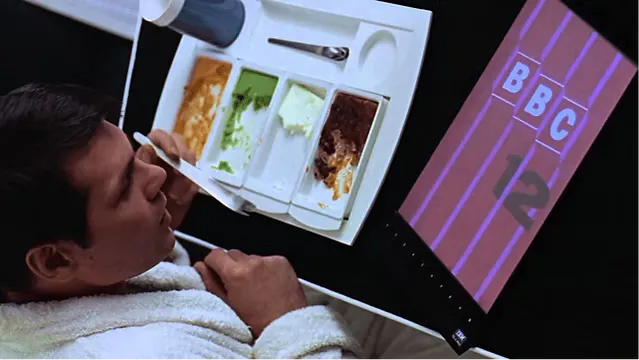
Arne Jacobsen stainless steel flatware for Georg Jensen, 1957. Used by the Jupiter Mission crew onboard Discovery I in *2001: A Space Odyssey*. Image: © Warner Bros. Entertainment Inc.

Arne Jacobsen stainless steel flatware for Georg Jensen, 1957. © Arne Jacobsen® Design I/S.
At the same time, Kubrick’s extreme perfectionism and commitment to realism does not preclude the insertion of certain whimsical components into the design vocabulary, with such details as the grip shoes, which enable the spacecraft flight attendant to walk upright in zero gravity, leaning into the kind of retro-futurism that reappears in the sets of Kubrick’s next blockbuster film, A Clockwork Orange (1971).
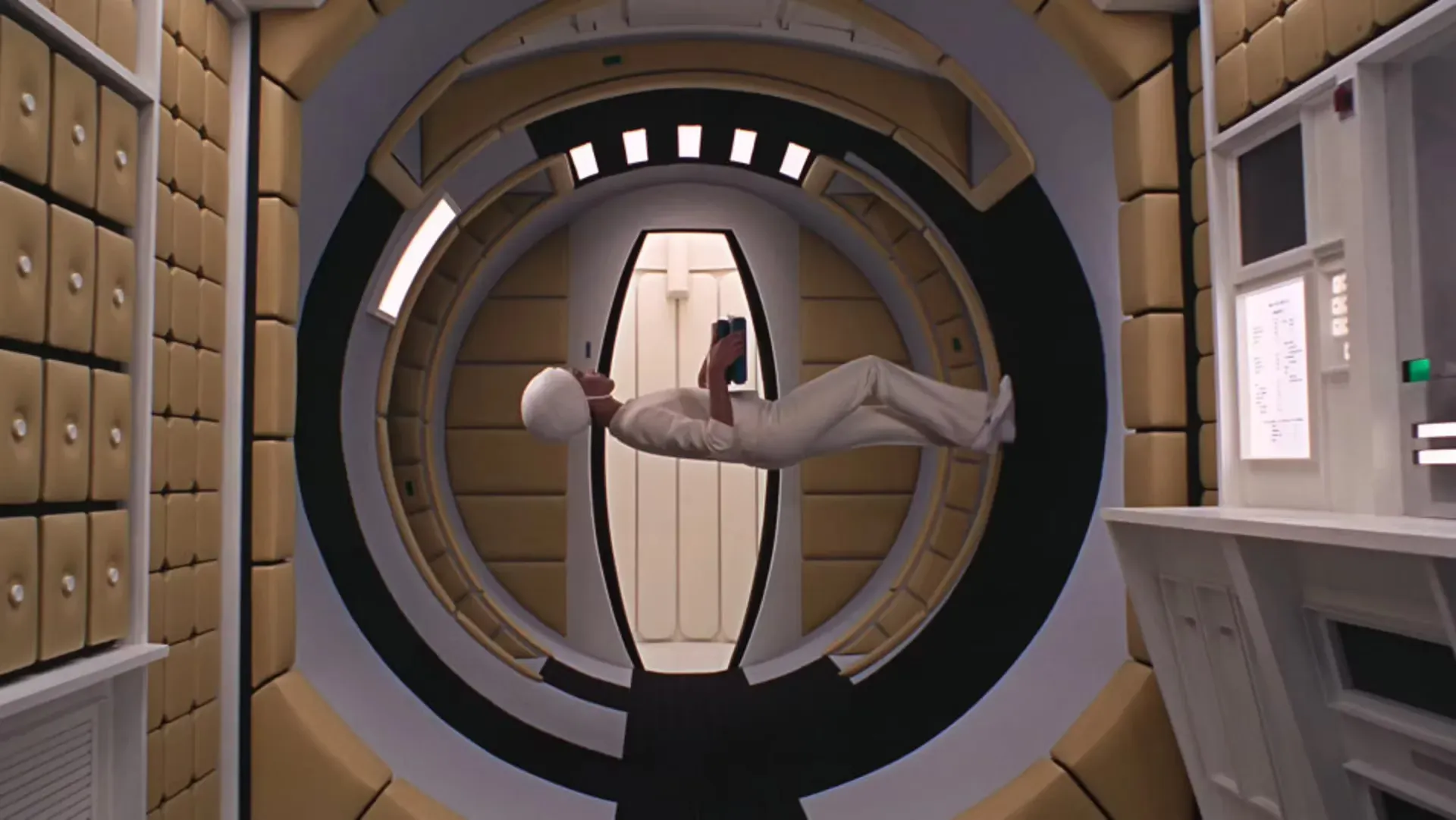
The flight attendant in Space Station V, wearing grip shoes and climbing the cylindrical walls of the spacecraft. Image: © Warner Bros. Entertainment Inc.
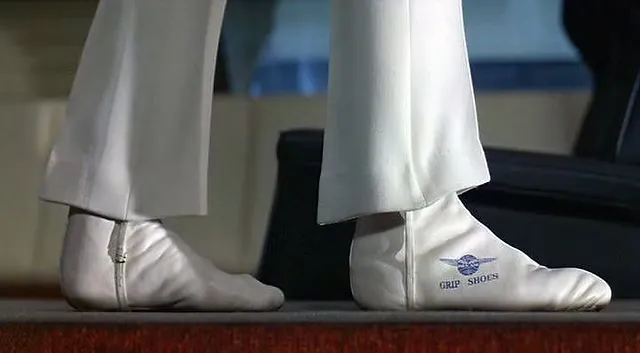
Grip shoes, worn by the flight attendant in Space Station V. Image: © Warner Bros. Entertainment Inc.

